The City of Toronto wants you to think the research is settled. Here is what it really says [pasted below, please cite and reference this important study!]: doi:10.3389/fevo.2026.1885888
Reframing coexistence: the need for threshold-based intervention in urban coyote management
Dennis L. Murray¹*, Emily Foucault², Keith Patton²
¹ Department of Biology, Trent University, Peterborough, ON, Canada ² Coyote Safety Coalition, Toronto, ON, Canada
* Correspondence: Dennis L. Murray, [email protected]
Frontiers in Ecology and Evolution 14:1885888 · Published 15 July 2026 doi:10.3389/fevo.2026.1885888
Republished in full under the Creative Commons Attribution License (CC BY). Full citation and licence terms at the foot of this page.
Abstract
Urban wildlife management increasingly operates within coexistence frameworks aimed at reconciling human and animal interests. However, these approaches can fail when escalating wildlife problems produce asymmetric risk across citizens. We identify a coexistence-mediated governance gap in contemporary urban wildlife policy arising from decoupling ethical commitments to animal welfare from the operational duty of care owed to the public. Using urban coyote management in Toronto, Canada, we illustrate how continued reliance on aversive conditioning (hazing), even after predatory behavioral markers are breached, delays escalation to more effective interventions. Despite consistent evidence demonstrating limitations of hazing in controlling emboldened or predatory coyotes, a review of municipal policies illustrates that coexistence remains broadly entrenched across urban centers in North America, thereby potentially promoting institutional inertia and shifting risk onto vulnerable groups. To address this shortcoming, we propose a threshold-based governance model in which management responses are anchored to predefined, objective data, driven by behavioral markers. Consistent with broader institutional design principles, a priori escalation criteria reduce discretionary delay, insulate decision-makers from ad hoc political pressure, and ensure that coexistence is conditionally bounded by transparent and defensible intervention thresholds.
Keywords: coexistence, coyote, evidence-based governance, Toronto, urban wildlife, wildlife management
Introduction
Urban wildlife conflicts are increasingly common where rapid human development and expansion of behaviorally malleable species intersect with efforts to preserve semi-natural urban landscapes (Magle et al., 2012). Effective urban wildlife management therefore requires a nuanced approach that accounts not only for damage mitigation but also for public values, uneven risk tolerance, and political sensitivity surrounding animal welfare (Patterson et al., 2003). The rise of animal rights and welfare advocacy has appropriately rendered practices such as poisoning and indiscriminate culling broadly unacceptable in contemporary wildlife management (Dubois et al., 2017; Treves et al., 2016). However, a significant governance gap emerges when these ethical commitments are decoupled from empirical risk assessment (Smith et al., 2023). In such contexts, frameworks emphasizing nature reconciliation can be weighed comparably to established science and best practices in wildlife management, narrowing the range of interventions to those deemed socially acceptable (Redpath et al., 2013; Carter and Linnell, 2016). Accordingly, urban wildlife governance may operate within a constrained decision space where symbolic coexistence strategies are politically safer than evidence-based intervention, despite established empirical support and elevated safety and institutional liability risks (Patterson et al., 2003; Hunold and Mazuchowski, 2020). Thus, institutions may be structurally incentivized to favor delay and symbolic action because political costs of decisive lethal action are immediate and attributable whereas consequences of inaction have less urgency and diffuse attribution.
This tension highlights a deeper systemic issue related to the type and timing of acceptable intervention with problem wildlife. There is a disconnect between the philosophical goal of human-wildlife "coexistence" versus its contemporary operationalization in urban landscapes. Broadly defined, coexistence envisions a dynamic state where humans and wildlife share landscapes governed by institutions that maintain wildlife population persistence alongside social legitimacy and tolerable risk (Carter and Linnell, 2016; König et al., 2020). Although the functional application of these principles may vary regionally or by species, this framework explicitly accepts conflict and accommodates targeted lethal management, relying on institutions to actively weigh trade-offs and manage risk using a diverse toolkit (Hill, 2021; Nyhus, 2016). However, in the context of modern urban governance this philosophy can morph into the acceptance of problem wildlife as permanent residents with explicit rights to shared spaces (Hill, 2021; Brady, 2016). Under this paradigm, municipal institutions may relegate lethal control to an ambiguous measure of last resort, even in the face of accumulating safety and liability risks (Hunold and Mazuchowski, 2020). In practice, this position can manifest as rigid adherence to public education and hazing as permanent substitutes for decisive intervention. Consequently, core tenets of true coexistence, like the maintenance of tolerable risk and institutional agility become compromised, allowing some problem behaviors and ineffective municipal responses to persist indefinitely. This management failure can lead to asymmetric risk distribution across the citizenry (see Slovic, 1987) and thereby frames the tension underlying much contemporary urban coyote management across North America (Oleyar, 2010; Brady, 2016).
Coyote ecology and the limits of behavioral deterrence
Urban coyotes are generalist predators whose success in human-dominated landscapes is driven by behavioral plasticity, access to anthropogenic food resources, and tolerance of human activity. Across North America, coyotes can occupy densely populated environments, exploiting greenspace and residential neighborhoods for movement and foraging (Gese et al., 2012). Although most urban coyotes are secretive and exhibit strong human avoidance, sustained exposure to human-associated food sources, whether through unsecured waste or deliberate provisionment by residents, promotes habituation and increased boldness (Estien et al., 2025). These behavioral shifts are well-documented precursors to conflict escalation, marked by reduced avoidance behavior and elevated risk of aggressive or predatory encounters with domestic animals and humans (Farr et al., 2019; Breck et al., 2019).
Urban coyote habituation is often expressed through increased boldness and aggression toward domestic dogs, including when dogs approach den sites or are present during pup-rearing and weaning (Farr et al., 2019). Coyote-dog encounters are often agonistic, diagnostically characterized as growling, barking, circling, or bluff charges, typically without physical contact and ending once the dog is removed (Boydston et al., 2018). In some situations, coyotes attack dogs without obvious provocation, and a subset of these encounters is predatory, involving distinct evidence of stalking, chasing, attack, and bite-shaking (Boydston et al., 2018). Predatory encounters are disproportionately directed at smaller dogs and can result in severe injury or death, with coyotes attempting to remove the dog from the site and sometimes caching carcasses in secluded locations. These behaviors are consistent with prey-handling strategies in wild coyotes (Wells and Bekoff, 1982), indicating predatory rather than defensive motivation.
Occasionally, urban coyotes display defensive aggression toward humans, either through direct contact or via coyote interactions with leashed dogs (Bombieri et al., 2018; Drake et al., 2021). Many incidents seemingly coincide with breeding (Drake et al., 2021) or pup-rearing (White and Gehrt, 2009), possibly reinforcing their defensive motivation. In a subset of incidents human-coyote interactions appear to be predatory, usually involving pedestrians, runners or cyclists (often children) being chased without provocation (White and Gehrt, 2009), in a manner similar to predatory interactions with larger prey in the wild. A smaller number of attacks involve motionless humans. Humans very rarely succumb to serious injury from such attacks (Baker and Timm, 2017). Thus, as a diagnostic rule-of-thumb coyote encounters with dogs or humans that are motivated by defensive aggression involve overt displays and restrained and context-dependent bluff or attack, whereas predatory attacks are more covert and targeted at vulnerable individuals, often while in motion (Wells and Bekoff, 1982; White and Gehrt, 2009).
Management responses to early-stage coyote habituation typically emphasize public education, attractant control, enforcement of wildlife-feeding bylaws, and aversive conditioning (hazing) (Breck et al., 2017; Lajeunesse et al., 2023). Studies reveal that hazing produces measurable avoidance only when applied consistently and intensively in early stages of habituation, and even then effects are typically short-lived and context-dependent (Timm et al., 2004; Schmidt and Timm, 2007; White and Delaup, 2012; Breck et al., 2017; Young et al., 2019). Responsiveness varies with individual experience, behavioral profile, and ecological conditions such as pup-rearing or continued access to anthropogenic food sources (Murray et al., 2015; Young et al., 2019). As a result, any benefit of hazing is restricted to select early-stage cases with low-severity conflict. To be clear, once coyotes exhibit persistent daytime activity in high-use areas, repeated close approaches, stalking behavior, predatory attacks on dogs, or unprovoked aggression toward humans, there is no robust empirical evidence suggesting that hazing reliably reverses these behaviors or meaningfully reduces subsequent risk (Breck et al., 2017; Young et al., 2019; Lajeunesse et al., 2025; see also Shivik, 2006). Under such conditions, continued reliance on hazing represents a policy drift beyond empirically demonstrated limits of the management tool.
Widespread adoption of hazing as a primary municipal response for addressing urban coyote problems across North America is rooted in the misinterpretation of positive responses to early-stage or low-severity conflict (Oleyar, 2010). This overgeneralization is reinforced by animal advocacy dynamics favoring non-lethal solutions and broadly influencing municipal coyote management policies (Brady, 2016). Accordingly, continued adherence to a coexistence policy framed by hazing and subjective intervention timing is incompatible with municipal responsibility to ensure public safety and mitigate liability.
A recent example of urban coyote management failure
A recent urban coyote conflict in downtown Toronto, Canada, illustrates these concerns. In 2024–25, four resident coyotes occupied one of the most densely populated urban neighborhoods in Canada, with escalating reports including repeated lethal attacks on domestic dogs and increasingly bold behavior toward humans (Figure 1). Between November 2024 and May 2025, at least 335 incidents were reported, with 106 involving menacing or stalking, 43 attacks, 2 dog deaths and 2 human attacks (City of Toronto, 2025a). Municipal authorities relied on socially acceptable responses like public education and low intensity (i.e., non-aggressive, non-projectile) hazing as a deterrent, with the official perception being that hazing was effective in repelling problem animals and mitigating conflict (City of Toronto, 2025a; Supplementary Material). After several months and as incidents became more frequent and severe, an expert panel was convened, recommending augmenting low intensity hazing; lethal control was to be reserved as a last resort (LURA Consulting, 2025). For several additional weeks the municipality increased hazing and reported positive outcomes (City of Toronto, 2025b), but conflict reports persisted until, unannounced, in early May 2025 two coyotes were euthanized. Aggressive encounters ceased immediately thereafter (Figure 1) and the two remaining animals were no longer observed.
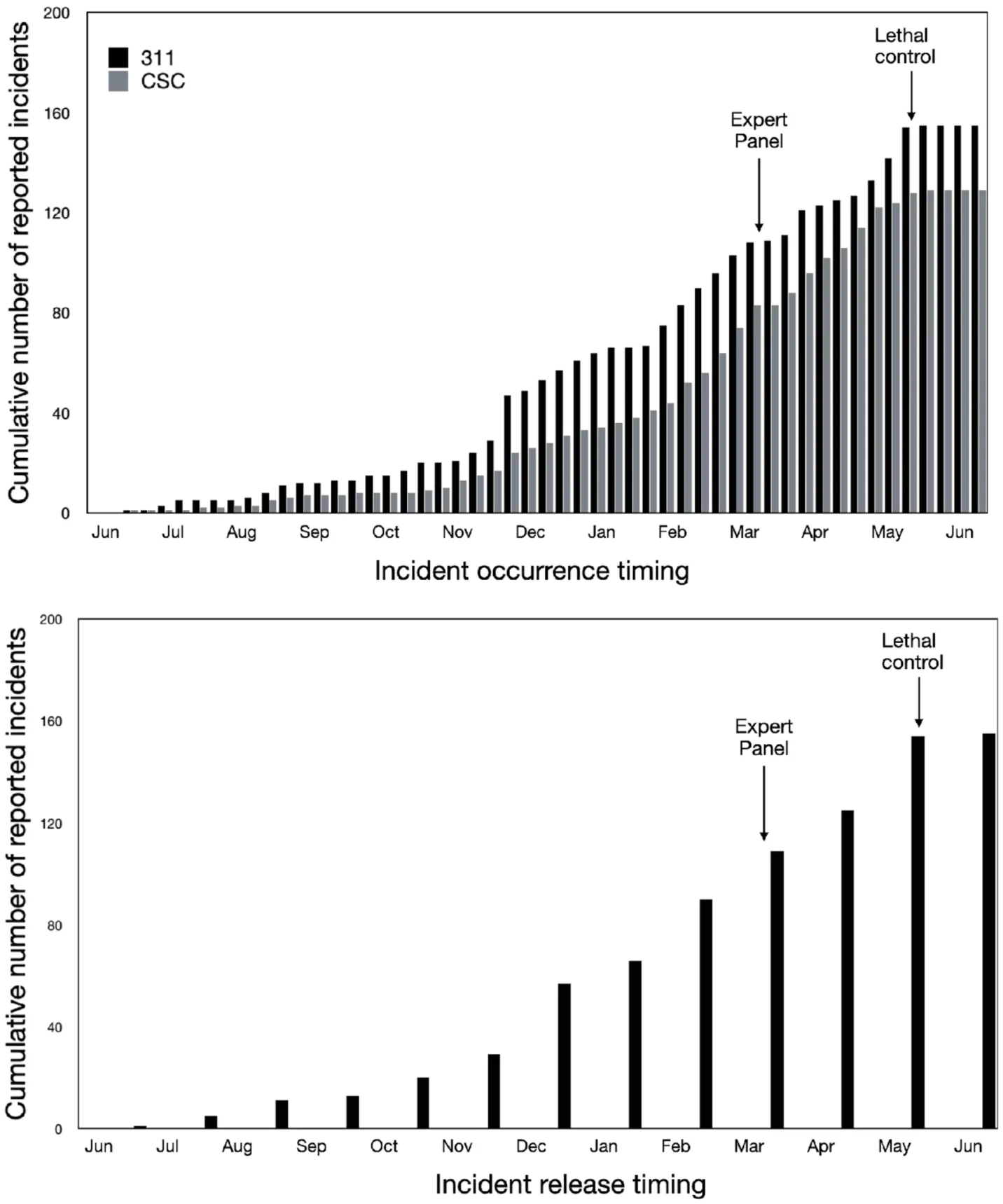
Figure 1
Bar chart with two panels comparing cumulative number of reported incidents over one year. Top panel shows two data sources, 311 (black bars) and CSC (gray bars), plotted by incident occurrence. Bottom panel shows total incidents by release timing using only black bars, with similar inflection points for Expert Panel and Lethal control events.
Timeline of urban coyote incidents collated by the City of Toronto (311) and the Coyote Safety Coalition (CSC), in the Liberty Village/Fort York area of Toronto, Ontario, Canada (June 2024 – May 2025). The City of Toronto dataset (City of Toronto, 2025a) was compiled through voluntary reports submitted to a non-emergency (311) phone/online hotline, and the Coyote Safety Coalition (CSC) dataset was compiled though voluntary reports submitted to the group's website (www.coyotesafetytoronto.ca). Both datasets originate from largely the same data (with minor discrepancies) and the CSC reporting system encouraged respondents to also file incident reports with the municipality. The close association between datasets indicates that structured integration of community-based reporting into formal surveillance systems represents a successful early warning system and may enhance early detection of behavioral markers. Top panel shows incident rates for both datasets relative to the week that the incident occurred; bottom panel shows incident rates from the City of Toronto (311) according to the municipality's monthly release timing and public notification. No incidents were reported in either dataset after the first week of May 2025. See Supplementary Material for additional Information.
Several aspects of this case are instructive. First, prolonged reliance on low intensity hazing allowed the conflict to escalate, whereas resolution occurred immediately after targeted lethal control. Although inference is correlational, this outcome is consistent with findings that hazing is not effective for addressing serious urban coyote problems (Timm et al., 2004; Breck et al., 2017; Young et al., 2019). Oleyar (2010) reviewed similar incidents across North America, where serious coyote problems only resolved after targeted euthanasia. In Toronto, delayed implementation of lethal control allowed risk to accumulate unnecessarily, culminating in additional pet mortalities and marked stress and conflict in the community. This reflects a failure to recognize the limits of a coexistence policy once escalation markers were breached, with interventions occurring in an ad hoc manner as risks became elevated. Second, convening an expert panel at a late stage in the conflict altered the decision context. Rather than evaluate robust incidence data relative to predefined behavioral markers, the panel operated reactively under intense public scrutiny, where panel composition and objectivity were questioned (Murray, 2025; see Rowe et al., 2013; Morgan, 2014). Third, the municipality lacked transparency in data collection and timely knowledge dissemination, prompting citizens to collect and release their own data (Figure 1; Supplementary Material). Ultimately, timing, transparency and rationale for policies were insufficient, suggesting that the municipality did not exercise discretion and raising questions about whether operational duty of care was fully met.
City of Toronto's decision to redeploy hazing despite clear evidence that key escalation markers (persistent daytime activity, repeated close approaches, predatory attacks on dogs, aggression toward humans) had already been breached, illustrates a gap in institutional governance. Escalation decisions appeared improvised under pressure, with absence of predefined responses effectively converting a technical wildlife issue into a politicized dialogue over acceptable risk. Surprisingly, City of Toronto's recently revised urban coyote management strategy (City of Toronto, 2025b; 2025c) continues to favor graduated hazing despite its known limitations (see Schmidt and Timm, 2007; Lajeunesse et al., 2025), as well as reliance on administrative discretion rather than a priori escalation thresholds triggered by objective measures of coyote behavior. This subjective approach is consistent with policies in other municipalities facing urban coyote problems (Table 1), indicating that altered coexistence philosophy remains a widespread barrier to evidence-based reform and making symbolic governance and administrative optics dominate public safety (Brady, 2016). This exposes municipalities to claims that they are waiving discretionary immunity (i.e., distinction between core policy vs. operational negligence; see Nelson (City) v. Marchi, 2021 SCC 41).
Table 1
Summary comparison of urban coyote management frameworks across select North American municipalities.
| Policy type | Representative municipalities | Key features |
|---|---|---|
| Informal coexistence frameworks | Vancouver (BC); Ottawa (ON); Seattle (WA); San Francisco (CA); Calgary (AB); Edmonton (AB) | Education, attractant control, hazing emphasized; limited or no formal behavioral classification; escalation discretionary and rarely specified |
| Structured coexistence frameworks | Toronto (ON); Mississauga (ON); Markham (ON); Vaughan (ON); Burlington (ON) | Incident classification or response tables present; escalation guidance exists but remains discretionary; hazing is central |
| Semi-structured risk-based frameworks | Los Angeles (CA); Denver (CO); Portland (OR); Chicago (IL) | Behavioral classification systems used; higher-severity categories permit stronger intervention; no fixed behavioral thresholds triggering mandatory action |
| Excluded/insufficient documentation | Niagara Region (ON); Phoenix (AZ); Tucson (AZ); Superior (CO) | No clear, citable primary policy documents located or only generic/state-level guidance; excluded from formal classification |
Jurisdictions were initially drawn from those surveyed by the City of Toronto during its 2025 revision of urban coyote management, with additional major urban programs included to capture broader policy variation. To facilitate comparison, municipal policies were grouped according to their dominant management, but because many jurisdictions publish fragmented guidance statements rather than comprehensive policies, summary categories represent qualitative groupings and are not necessarily exclusive. Broadly speaking, policies consistently emphasize coexistence strategies centered on public education, attractant control, and aversive conditioning (hazing), which are in line with coexistence-based management. Many municipalities advocate a graduated hazing model, where low intensity aversion is performed by residents and severity is progressively increased, often through municipal teams or private contractors. High intensity hazing (i.e., projectiles) is rarely specified and in some cases discouraged, despite evidence suggesting that it may be more effective and that graduated hazing may be counter-productive (Bonnell and Breck, 2017; Breck et al., 2017; 2019; Lajeunesse et al., 2025). Escalation to lethal control is typically discretionary and framed as a last-resort response rather than being triggered by behavioral thresholds, with policies rarely distinguishing between reversible defensive aggression and irreversible predatory escalation. The fragmented nature and inconsistent documentation of municipal policies suggests that they are often operationalized with discretion. Additional policy descriptions and source documents for each municipality are provided in the Supplementary Material.
Debatable arguments against lethal control
There are broader ethical inconsistencies in urban coyote management, where perception of short-term animal welfare and sentience obscures longer-term welfare and risk considerations. Critics commonly equate urban coyote euthanasia to large-scale predator control campaigns (Hunold and Mazuchowski, 2020) despite that targeted removal of select coyotes in urban areas is categorically different from large-scale coyote population control in rural landscapes (Oleyar, 2010). The former addresses an acute public safety risk in a densely populated, human-dominated setting but does not seek to alter population demography. Conflating these fundamentally different interventions as ethically or ecologically equivalent misrepresents urban coyote management goals. Urban coyote advocates sometimes suggest that lethal control is ineffective because new coyotes will rapidly colonize vacant territories and problems will resume (LURA Consulting, 2025), but this position omits that the goal is removal of specific problem animals. Immigrant coyotes that colonize vacated territories should not cause additional problems if ultimate causes of habituation (i.e., access to human foods) are addressed (Oleyar, 2010). Likewise, claims that lethal control may elicit compensatory reproduction or immigration of surplus animals into newly vacated territories (e.g., White and Delaup, 2012; Draheim et al., 2019) are not supported in the context of targeted removal of problem individuals.
Selective control of problem individuals is often viewed as more ethically acceptable than whole-group removal (Ramp and Bekoff, 2015), but this opinion also warrants further scrutiny (see Swan et al., 2017). Free-ranging coyotes are difficult to distinguish when part of a larger group (White and Delaup, 2012), and multiple individuals are often involved in problem encounters. In Toronto, reports indicated that up to 3 individuals were simultaneously involved in attacks (Supplementary Material), meaning that euthanizing only 2 individuals could have excluded some problem animals. Coyote groups are mainly comprised of family units, and problem behaviors may be transferred from parents to offspring (Schell et al., 2018). Further, selective removal may cause loss of social cohesion (Brainerd et al., 2008; Van der Weyde et al., 2016) and thus add additional stress to remaining animals. Alternatively, coyotes surviving after lethal control of pack-mates may disperse or become increasingly wary of humans (Baker and Timm, 1998). Regardless, earlier, decisive intervention may be more humane than prolonged attempts to sustain coexistence after escalation thresholds are breached and markers indicate irreversible behavioral change.
Coyotes experience stress and trauma, and widespread consensus appropriately demands that management minimize unnecessary suffering (Dubois et al., 2017; Hunold and Mazuchowski, 2020). However, reliance on non-lethal deterrents with emboldened coyotes may be ethically counterproductive if the treatment is ineffective and targeted animals experience persistent additional stress from repeated hazing before ultimately being euthanized. Prolonged hazing of emboldened coyotes thereby may constitute unnecessary harassment with no positive outcome. Relocating problem coyotes is often proposed as a humane alternative (Draheim et al., 2019), but translocation can face legal hurdles, displace conflict to other areas, expose released animals to territorial aggression from conspecifics, or result in high post-release mortality (Massei et al., 2010; Learn, 2021; City of Toronto, 2025c). Likewise, placement in captive facilities is also a popular suggestion (Liordos et al., 2017) but raises additional welfare concerns for wild-caught animals subjected to prolonged confinement and stress (Fischer and Romero, 2019; Dickens et al., 2010). Thus, proponents of protracted hazing or relocation for emboldened coyotes may prioritize perceived short-term welfare over longer-term outcomes grounded in biological evidence. Ultimately, avoiding lethal intervention when habituation is irreversible does not necessarily represent an ethically or morally superior outcome.
Threshold-based governance
Public officials tasked with urban wildlife management must translate objective scientific evidence into operational thresholds that consider public safety (see Schmidt and Timm, 2007). This step is key to responsible governance and requires clearly articulated behavioral milestones that are evidence-based and prompt timely and defensible responses. Lethal control thresholds should be anchored to observable indicators that account for behavior type and its ecological and situational context. For example, defensive aggression associated with pup rearing, dog harassment, or other identifiable aggravators may reflect transient, context-dependent responses that may be addressed through targeted non-lethal measures such as temporary site closures and restricted access (Figure 2). These responses can be determined objectively from contextual analysis of incident reports, but this level of municipal investigative commitment is not evident in urban coyote management policy (Table 1).
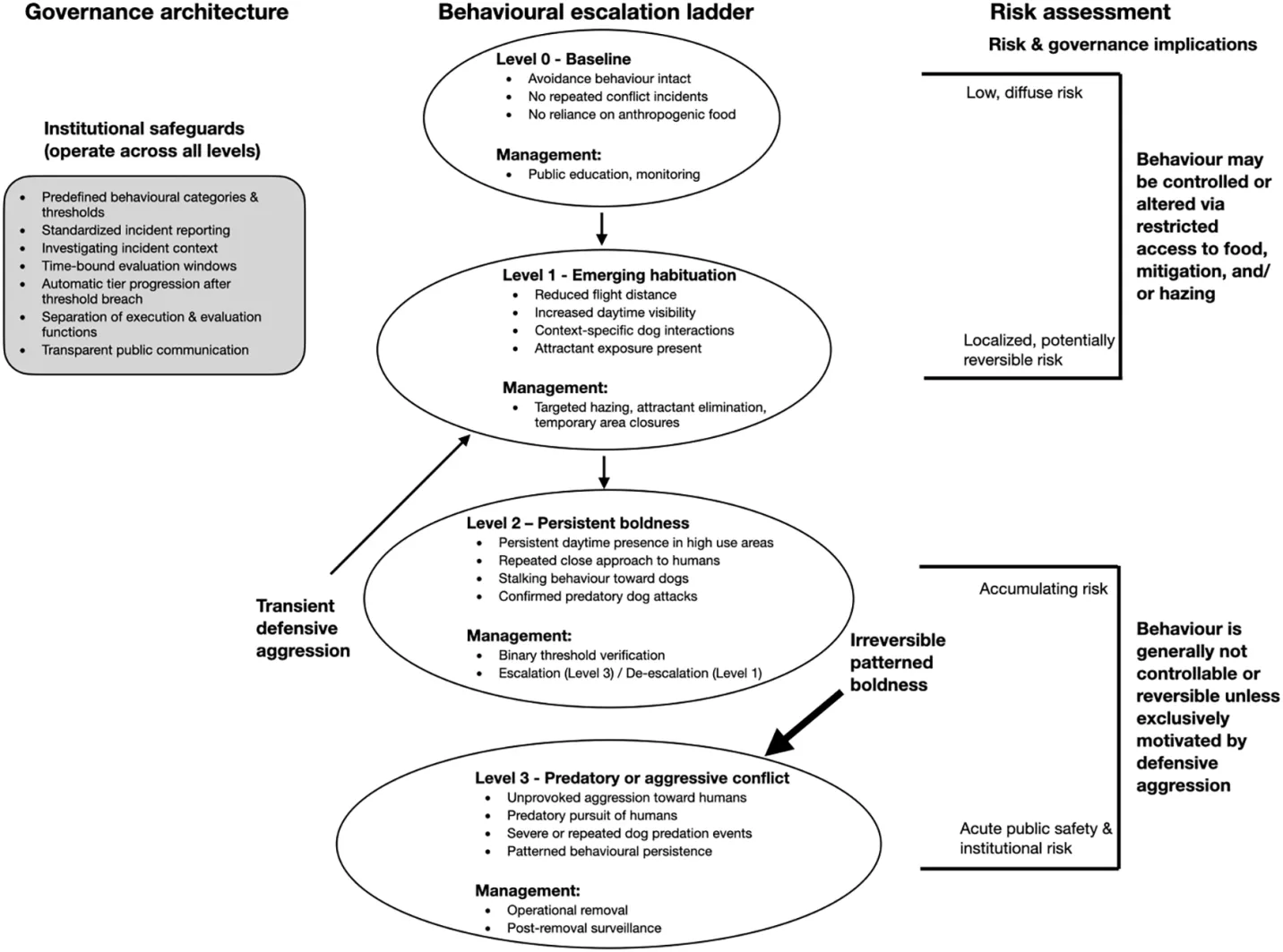
Figure 2
Diagram: a behavioural escalation ladder with four levels from baseline to predatory conflict, and associated risk assessment.
Conceptual framework linking governance architecture, behavioral escalation, and corresponding risk in urban coyote management. Behavioral categories are defined a priori based on established knowledge about coyote behavior, and aligned with structured intervention tiers to eliminate administrative drift. Level 0 behaviors require baseline monitoring and public education only. Level 1 behaviors are potentially reversible and addressed through mitigation (e.g., education, attractant control) and possibly active deterrence (hazing). Based on the best available information (Schmidt and Timm, 2007; Lajeunesse et al., 2025), hazing should be high intensity at the onset of habituation rather than graduated. Level 2 acts as a binary verification stage where incidents are categorized as either transient defensive aggression (e.g., situational den-site protection) or patterned boldness. Unlike contemporary escalation threshold models that rely on administrative discretion, this framework treats emergence of patterned boldness as a trigger for escalation. Level 3 behaviors represent an acute threshold breach (e.g., predatory stalking, unprovoked human-directed aggression) necessitating immediate removal. Progression between tiers is triggered by predefined behavioral markers rather than subjective assessment, thereby reducing discretionary delay and insulating decision-makers from advocacy pressure. By anchoring intervention to these objective behavioral milestones, the framework replaces institutional frailties with an evidence-based, mandatory public duty of care. Institutional safeguards operate across all tiers to ensure transparency, accountability, and defensible action.
Once irreversible behavioral escalation markers are met (e.g., persistent daytime presence in high-use areas combined with repeated close approaches to humans, stalking behavior, or predatory attacks on dogs), the trajectory toward conflict resolution becomes an operational mandate based on evidentiary markers, and failure to escalate at this stage shifts management from structured mitigation to reactive crisis response. Under such conditions decisions are driven by accumulating incidents rather than predefined standards, thereby weakening objective assessment and administrative transparency. Analogously, there are no randomized control trials demonstrating benefits of wearing a parachute when jumping out of an airplane (Smith and Pell, 2003), meaning that absence of experimental evidence of hazing's failure in a specific conflict situation does not preclude lethal action given the preponderance of scientific evidence and when risk thresholds are clearly exceeded. Thus, there should be no need for consultation, additional data collection, expert panel advice, or escalatory hazing if problem animals breach predatory thresholds and irreversibly augment risks. Ultimately, predefined thresholds constrain discretionary decision making, helping ensure that a municipality's overarching coexistence policy does not lead to functional negligence and potential neglect of the operational duty of care (see Nelson (City) v. Marchi, 2021).
Importantly, predefined intervention thresholds protect not only public safety but also institutional integrity. Established thresholds reduce political influence and insulate officials from ad hoc advocacy pressure. Accordingly, threshold-based wildlife management mirrors public health models where predefined indicators reduce delay and protect both the public and decision-makers (Castillo-Laborde et al., 2020; Meckawy et al., 2022). In public health, predefined epidemiological indicators trigger graduated interventions, reducing discretionary delay and late-stage political negotiation.
Operational design of a threshold-based system
Several design features are essential for successful threshold-based urban coyote management. First, behavioral markers must be evidence-based, clearly defined, and publicly articulated, distinguishing transient defensive responses from sustained escalation (Figure 2). This level of detail and interpretation are typically lacking from municipal coyote management policies (Table 1). Second, standardized incident documentation and centralized reporting are needed to ensure rapid information availability. In the case of Toronto, official release of incident reports was delayed by weeks (Figure 1; Supplementary Material), thereby creating an information asymmetry and precluding rapid institutional intervention and mitigative responses by the public. Threshold-free management frameworks inherently reduce informational requirements for decision-making, which can promote delinquencies in data collection, delayed reporting, and limited evaluation of intervention effectiveness. In Toronto, the citizen-led early warning system (Figure 1; Supplementary Material) illustrates public efforts to establish workarounds to compensate for municipal lapses, thereby highlighting the perception that the state is neglecting the burden of safety. Third, escalation pathways must be time-bound, with persistence of predefined behaviors following intervention eliciting progression to the next management tier. This transition should occur automatically and be transparent, which was not the case in Toronto. Fourth, decision authority and accountability must be specified in advance, thereby avoiding the lack of institutional responsibility that erodes public support. Finally, communication protocols should transparently convey both behavioral criteria and rationale for action, reinforcing public understanding that intervention is evidence-based and adheres to established best practices. Such a framework reduces both perception and structural possibility of politically reactive decision-making, reinforcing that intervention follows transparent, defensible criteria.
It is important to highlight that exact frequency triggers and temporal windows constituting a threshold breach should be calibrated according to a municipality's localized ecological and demographic context. This may require some additional data collection as well as risk tolerance and resourcing analysis across adopting jurisdictions, a priori. Thus, a robust threshold-based system does require some up-front investment, and a municipality should not simply rely on thresholds recycled from other jurisdictions. Figure 2 provides a robust structural framework to help develop local calibration.
Importantly, a successful threshold-based response system requires that escalatory behaviors are clearly understood and defined, with thresholds that are informed by established, peer-reviewed, research findings. This is the case with the understood limits of hazing as a tool for managing problem coyotes (Breck et al., 2017; Timm et al., 2004; Schmidt and Timm, 2007; White and Delaup, 2012; Breck et al., 2017; Young et al., 2019; Lajeunesse et al., 2025). The system requires targeted resources to ensure that quality control and reliable data are available to support defensible escalation, with serious incidents prompting comprehensive investigation by trained personnel to validate corresponding elevation of escalation thresholds. As demonstrated by the community reporting platform for Toronto (Supplementary Material), subjective reports from a distressed public can be successfully filtered into objective field metrics by structured auditing of context-specific variables, including relevant features like domestic pet weight, leash compliance, coyote group size, and diagnostic behavioral markers like predatory bite-shaking versus defensive vocalization. Notably, such public safety audits are only needed for Level 2 and 3 incidents (Figure 2) and are inherently less expensive than the costs of inaction (or misguided intervention) in terms of human safety liability, operational costs of large-scale closures, impacts on public services and industries, hiring private hazing contractors, and municipal reputational damage. Necessarily, transitional management actions like hazing require surveillance by trained, arms-length personnel to provide objective measures of success. For example, if hazing is outsourced to private contractors its efficacy should be evaluated by independent auditors (Murray, 2025), whereas seasonal site closures or restrictions require enforcement by appropriate bylaws and officers. In other risk-regulated domains such as food safety inspection and financial auditing, execution and evaluation functions are deliberately separated to preserve credibility and reduce bias (Gipper et al., 2020; Ze et al., 2025). In the public health realm, departments internalize case tracking and outbreak metrics so that core evaluative functions retain legitimacy (e.g., Meckawy et al., 2022).
Importantly, some institutional problems observed in Toronto (e.g., delayed data release, limited incident verification, lack of systematic monitoring) are not unique to coexistence-based frameworks and likely reflect broader administrative lapses and resource limitations. A municipality relying on discretionary, non-escalatory responses that are not supported by robust evidence reduces its operational demand for timely, high-resolution data, and thereby has weakened incentives for investment in rigorous monitoring and accountability systems. To be clear, municipal governance structures that commit to human-wildlife coexistence should not adopt laissez-faire management and data-free oversight.
Conclusion
Across North American municipalities, urban coyote management overwhelmingly relies on discretionary escalation within traditional coexistence frameworks (Table 1). Universally, recognized behavioral categories function as elevated risk indicators without contextualizing for reversible problem behaviors or being tied to explicit threat indicators. These shortcomings perpetuate a state of uncertainty for public officials and residents. Toronto's revised urban coyote management strategy (City of Toronto, 2025b; 2025c) retains structural flaws including graduated hazing intensity and subjective decisions on behavioral escalation, without evidence of fundamental reform to avoid past problems related to administrative indecision and delayed intervention. Such challenges appear to be ingrained across administrative bodies and municipal governments, reflecting success of contemporary animal advocacy dynamics, a morphed coexistence philosophy, and absence of a clearly defined, evidence-based counterargument. This flaw contributes to systemic erosion in public trust regarding urban wildlife management and for human-wildlife coexistence frameworks and nature conservation efforts more broadly.
Threshold-based governance emphasizes the intended principles of coexistence by defining conditions under which it remains viable, and when behavioral thresholds are irreversibly breached, requiring intervention (Redpath et al., 2013). Recognizing when coexistence philosophy has drifted from its original principles and when management goals are no longer attainable allows municipalities to balance ethical obligations to animals with responsibilities for public safety, risk mitigation, and institutional integrity. Coexistence therefore becomes bounded and accountable, thereby reframing urban wildlife management as a problem of asymmetric risk mitigation rather than exclusively one of aspirational reconciliation with nature.
Statements
Data availability. The datasets presented in this study can be found in online repositories. The names of the repository/repositories and accession number(s) can be found in the article/Supplementary Material.
Author contributions. DM: Writing – original draft, Writing – review & editing. EF: Conceptualization, Data curation, Validation, Writing – review & editing. KP: Conceptualization, Data curation, Methodology, Validation, Writing – review & editing.
Funding. The author(s) declared that financial support was not received for this work and/or its publication.
Acknowledgments. We are grateful to the residents of the Fort York/Liberty Village neighborhood for supporting the efforts of the Coyote Safety Coalition.
Conflict of interest. The author(s) declared that this work was conducted in the absence of any commercial or financial relationships that could be construed as a potential conflict of interest. The author DM declared that they were an editorial board member of Frontiers, at the time of submission. This had no impact on the peer review process and the final decision.
Generative AI statement. The author(s) declared that generative AI was not used in the creation of this manuscript.
Publisher's note. All claims expressed in this article are solely those of the authors and do not necessarily represent those of their affiliated organizations, or those of the publisher, the editors and the reviewers. Any product that may be evaluated in this article, or claim that may be made by its manufacturer, is not guaranteed or endorsed by the publisher.
Supplementary material. https://www.frontiersin.org/articles/10.3389/fevo.2026.1885888/full#supplementary-material
References
Baker, R. O., and Timm, R. M. (1998). Management of conflicts between urban coyotes and humans in Southern California. Proc. Vertebr. Pest Conf. 18, 110–118. doi: 10.5070/v418110164
Baker, R. O., and Timm, R. M. (2017). Coyote attacks on humans 1970–2015: Implications for reducing the risks. Hum.-Wildl. Interact. 11, 120–132. doi: 10.26077/jy37-s271
Bombieri, G., Delgado, M. D. M., Russo, L. F., Garrote, P. J., López-Bao, J. V., Fedriani, J. M., et al. (2018). Patterns of wild carnivore attacks on humans in urban areas. Sci. Rep. 8, 17728. doi: 10.1038/s41598-018-36034-7
Bonnell, M. A., and Breck, S. W. (2017). Using resident-based hazing programs to reduce human-coyote conflicts in urban environments. Hum.-Wildl. Interact. 11, 5. doi: 10.26077/ab7k-6j25
Boydston, E. E., Abelson, E. S., Kazanjian, A., and Blumstein, D. T. (2018). Canid vs. canid: Insights into coyote–dog encounters from social media. Hum.-Wildl. Interact. 12, 233–242. doi: 10.26077/ab4z-t030
Brady, S. A. (2016). "The problematic trend of pseudo-science dictating urban coyote management policy," in Proceedings of the 27th Vertebrate Pest Conference (Davis: Univ. of California), 112–116.
Brainerd, S. M., Andrén, H., Bangs, E. E., Bradley, E. H., Fontaine, J. A., Hall, W., et al. (2008). The effects of breeder loss on wolves. J. Wildl. Manage. 72, 89–98. doi: 10.2193/2006-305
Breck, S. W., Poessel, S. A., and Bonnell, M. A. (2017). Evaluating lethal and nonlethal management options for urban coyotes. Hum.-Wildl. Interact. 11, 4. doi: 10.26077/q5s9-vk08
Breck, S. W., Poessel, S. A., Mahoney, P., and Young, J. K. (2019). The intrepid urban coyote: A comparison of bold and exploratory behavior in coyotes from urban and rural environments. Sci. Rep. 9, 2104. doi: 10.1038/s41598-019-38543-5
Carter, N. H., and Linnell, J. D. C. (2016). Co-adaptation is key to coexisting with large carnivores. Trends Ecol. Evol. 31, 575–578. doi: 10.1016/j.tree.2016.05.006
Castillo-Laborde, C., de Wolff, T., Gajardo, P., Lecaros, R., Olivar-Tost, G., and Ramírez, H. (2020). Assessment of event-triggered policies of nonpharmaceutical interventions based on epidemiological indicators. J. Math. Biol. 83, 42. doi: 10.1007/s00285-021-01669-0
City of Toronto (2025a). Downtown Coyote Action Plan. https://www.toronto.ca/legdocs/mmis/2025/ec/bgrd/backgroundfile-254881.pdf
City of Toronto (2025b). Updated Coyote Coexistence and Response Strategy. https://www.toronto.ca/legdocs/mmis/2025/ec/bgrd/backgroundfile-256788.pdf
City of Toronto (2025c). The City of Toronto's Coyote Coexistence and Response Strategy. 18pp. https://www.toronto.ca/wp-content/uploads/2025/07/9864-coyote-coexistence-response-strategy.pdf
Dickens, M. J., Delehanty, D. J., and Romero, L. M. (2010). Stress: An inevitable component of animal translocation. Biol. Conserv. 143, 1329–1341. doi: 10.1016/j.biocon.2010.02.032
Draheim, M. M., Parsons, E. C. M., Crate, S. A., and Rockwood, L. L. (2019). Public perspectives on the management of urban coyotes. J. Urban Ecol. 5, juz003. doi: 10.1093/jue/juz003
Drake, D., Dubay, S., and Allen, M. L. (2021). Evaluating human–coyote encounters in an urban landscape using citizen science. J. Urban Ecol. 7, juaa032. doi: 10.1093/jue/juaa032
Dubois, S., Fenwick, N., Ryan, E. A., Baker, L., Baker, S. E., Beausoleil, N. J., et al. (2017). International consensus principles for ethical wildlife control. Conserv. Biol. 31, 753–760. doi: 10.1111/cobi.12896
Estien, C. O., Stanton, L. A., and Schell, C. J. (2025). Differential effects of human density, environmental health, and group size on urban coyote detection, boldness, and exploration. Sci. Rep. 15, 38072. doi: 10.1038/s41598-025-21946-y
Farr, J. J., Pruden, M. J., Glover, R. D., Murray, M. H., Sugden, S. A., Harshaw, H. W., et al. (2019). A ten-year community reporting database reveals rising coyote boldness and associated human concern in Edmonton, Canada. Ecol. Soc. 28, 19. doi: 10.5751/ES-14015-280219
Fischer, C. P., and Romero, L. M. (2019). Chronic captivity stress in wild animals is highly species-specific. Conserv. Physiol. 7, coz093. doi: 10.1093/conphys/coz093
Gese, E. M., Morey, P. S., and Gehrt, S. D. (2012). Influence of the urban matrix on space use of coyotes in the Chicago metropolitan area. J. Ethol. 30, 413–425. doi: 10.1007/s10164-012-0339-8
Gipper, B., Leuz, C., and Maffett, M. (2020). Public oversight and reporting credibility: Evidence from the PCAOB audit inspection regime. Rev. Financ. Stud. 33, 4532–4579. doi: 10.1093/rfs/hhz149
Hill, C. M. (2021). Conflict is integral to human-wildlife coexistence. Front. Conserv. Sci. 2, 734314. doi: 10.3389/fcosc.2021.734314
Hunold, C., and Mazuchowski, M. (2020). Human-wildlife coexistence in urban wildlife management: Insights from nonlethal predator management and rodenticide bans. Animals 10, 1983. doi: 10.3390/ani10111983
König, H. J., Kiffner, C., Kramer-Schadt, S., Furst, C., Keuling, O., and Ford, A. T. (2020). Human-wildlife coexistence in a changing world. Conserv. Biol. 34, 786–794. doi: 10.1111/cobi.13513
Lajeunesse, G., Harshaw, H. W., and St. Clair, C. C. (2025). Urban coyotes were observed rarely and retreated consistently from assertive approaches by volunteers in neighborhoods. PLoS One 20, e0318127. doi: 10.1371/journal.pone.0318127
Lajeunesse, G., Smith, E. W., Harshaw, H. W., and St. Clair, C. C. (2023). Proactive use of intensive aversive conditioning increases probability of retreat by coyotes. Ecosphere 14, e4676. doi: 10.1002/ecs2.4676
Learn, J. P. (2021). TWS2021: Translocated nuisance coyotes have low survival (Wildlife News). https://wildlife.org/tws2021-translocated-nuisance-coyotes-have-low-survival/
Liordos, V., Kontsiotis, V. J., Georgari, M., Baltzi, K., and Baltzi, I. (2017). Public acceptance of management methods under different human–wildlife conflict scenarios. Sci. Total Environ. 579, 685–693. doi: 10.1016/j.scitotenv.2016.11.040
LURA Consulting (2025). Consolidated Summary Report: Expert Panel on Coyotes in Fort York/Liberty Village. Prepared for Toronto Animal Services (Municipal Licensing and Standards Division, City of Toronto), March 2025. https://www.toronto.ca/wp-content/uploads/2025/03/8fb1-Consolidated-Summary-Report-Expert-Panel-on-Coyotes-in-Fort-York-Liberty-Village-FINAL.pdf
Magle, S. B., Hunt, V. M., Vernon, M., and Crooks, K. R. (2012). Urban wildlife research: Past, present, and future. Biol. Conserv. 155, 23–32. doi: 10.1016/j.biocon.2012.06.018
Massei, G., Quy, R. J., Gurney, J., and Cowan, D. P. (2010). Can translocations be used to mitigate human–wildlife conflicts? Wildl. Res. 37, 428–439. doi: 10.1071/WR08179
Meckawy, R., Stuckler, D., Mehta, A., Al-Ahdal, T., and Doebbeling, B. N. (2022). Effectiveness of early warning systems in the detection of infectious diseases outbreaks: A systematic review. BMC Public Health 22, 2216. doi: 10.1186/s12889-022-14625-4
Morgan, M. G. (2014). Use (and abuse) of expert elicitation in support of decision making for public policy. Proc. Natl. Acad. Sci. 111, 7176–7184. doi: 10.1073/pnas.1319946111
Murray, D. L. (2025). Commissioned review of: Expert panel consolidated summary report: Expert panel on coyotes in Fort York/Liberty Village. Prepared for Coyote Safety Coalition. https://coyotesafetytoronto.ca/papers/
Murray, M., Edwards, M. A., Abercrombie, B., and St. Clair, C. C. (2015). Poor health is associated with use of anthropogenic resources in an urban carnivore. Proc. R. Soc. Lond. Ser. B 282, 20150009. doi: 10.1098/rspb.2015.0009
Nelson (City) v. Marchi (2021). SCC 41. Supreme Court of Canada. https://decisions.scc-csc.ca/scc-csc/scc-csc/en/item/19036/index.do
Nyhus, P. J. (2016). Human–wildlife conflict and coexistence. Annu. Rev. Environ. Resour. 41, 143–171. doi: 10.1146/annurev-environ-110615-085634
Oleyar, C. (2010). "How misinformation fosters human-coyote conflicts," in Proceedings of the 24th Vertebrate Pest Conference (Davis, CA: Univ. of California), 290–297. https://escholarship.org/uc/item/0gf5g5vq
Patterson, M. E., Montag, J. M., and Williams, D. R. (2003). The urbanization of wildlife management: Social science, conflict, and decision making. Urban For. Urban Greening 1, 171–183. doi: 10.1078/1618-8667-00017
Ramp, D., and Bekoff, M. (2015). Compassion as a practical and evolved ethic for conservation. BioScience 65, 323–327. doi: 10.1093/biosci/biu223
Redpath, S. M., Young, J., Evely, A., Adams, W. A., Sutherland, W. J., and Whitehouse, A. (2013). Understanding and managing conservation conflicts. Trends Ecol. Evol. 28, 100–109. doi: 10.1016/j.tree.2012.08.021
Rowe, S., Alexander, N., Weaver, C. M., Dwyer, J. T., Drew, C., Applebaum, R. A., et al. (2013). How experts are chosen to inform public policy: Can the process be improved? Health Policy 112, 172–178. doi: 10.1016/j.healthpol.2013.01.012
Schell, C. J., Young, J. K., Lonsdorf, E. V., Santymire, R. M., and Mateo, J. M. (2018). Parental habituation to human disturbance over time reduces fear of humans in coyote offspring. Ecol. Evol. 8, 12965–12980. doi: 10.1002/ece3.4741
Schmidt, R. H., and Timm, R. M. (2007). Bad dogs: Why do coyotes and other canids become unruly? Proc. 12th Wildl. Damage Manage. Conf. 71, 287–302. https://digitalcommons.unl.edu/cgi/viewcontent.cgi?article=1070&context=icwdm_wdmconfproc
Shivik, J. A. (2006). Tools for the edge: What's new for conserving carnivores. BioScience 56, 253–259. doi: 10.1641/0006-3568(2006)056[0253:TFTEWN]2.0.CO;2
Slovic, P. (1987). Perception of risk. Science 236, 280–285. doi: 10.1126/science.3563507
Smith, G. C. S., and Pell, J. P. (2003). Parachute use to prevent death and major trauma related to gravitational challenge: Systematic review of randomised controlled trials. Br. Med. J. 327, 1459. doi: 10.1136/bmj.327.7429.1459
Smith, C. A., Tantillo, J. A., Hale, B., Decker, D. J., Forstchen, A. B., Pomeranz, E. F., et al. (2023). A practical framework for ethics assessment in wildlife management decision-making. J. Wildl. Manage. 88, e22502. doi: 10.1002/jwmg.22502
Swan, G. J. F., Redpath, S. M., Bearhop, S., and McDonald, R. A. (2017). Ecology of problem individuals and the efficacy of selective wildlife management. Trends Ecol. Evol. 32, 518–530. doi: 10.1016/j.tree.2017.03.011
Timm, R. M., Baker, R. O., Bennett, J. R., and Coolahan, C. C. (2004). Coyote attacks: An increasing suburban problem. Trans. North Am. Wildl. Natural Resour. Conf. 69, 67–88. https://escholarship.org/uc/item/8qg662fb
Treves, A., Krofel, M., and McManus, J. (2016). Predator control should not be a shot in the dark. Front. Ecol. Environ. 14, 380–388. doi: 10.1002/fee.1312
Van der Weyde, L. K., Martin, G. B., and Paris, M. C. J. (2016). Monitoring stress in captive and free-ranging African wild dogs (Lycaon pictus) using faecal glucocorticoid metabolites. Gen. Comp. Endocrinol. 226, 50–55. doi: 10.1016/j.ygcen.2015.12.022
Wells, M. C., and Bekoff, M. (1982). Predation by wild coyotes: Behavioral and ecological analyses. J. Mammal. 63, 118–127. doi: 10.2307/1380678
White, L. A., and Delaup, A. C. (2012). "A new technique in coyote conflict management: Changing coyote behavior through hazing in Denver, Colorado," in Proceedings of the 14th WDM Conference, 133–137.
White, L. A., and Gehrt, S. D. (2009). Coyote attacks on humans in the United States and Canada. Hum. Dimens. Wildl. 14, 419–432. doi: 10.1080/10871200903055326
Young, J. K., Hammill, E., and Breck, S. W. (2019). Interactions with humans shape coyote responses to hazing. Sci. Rep. 9, 20046. doi: 10.1038/s41598-019-56524-6
Ze, Y., van Asselt, E. D., Focker, M., and van der Fels-Klerx, H. J. (2025). A comparative analysis of risk-based food safety inspection methods across EU countries and Canada. J. Food Sci. 90, e70592. doi: 10.1111/1750-3841.70592
Citation and licence
Murray DL, Foucault E and Patton K (2026) Reframing coexistence: the need for threshold-based intervention in urban coyote management. Front. Ecol. Evol. 14:1885888. doi: 10.3389/fevo.2026.1885888
Received 19 May 2026 · Revised 14 June 2026 · Accepted 17 June 2026 · Published 15 July 2026
Edited by Carlos González-Crespo, University of California, Davis, United States. Reviewed by László Patkó, Royal Commission of AlUla, Saudi Arabia.
© 2026 Murray, Foucault and Patton. This is an open-access article distributed under the terms of the Creative Commons Attribution License (CC BY). The use, distribution or reproduction in other forums is permitted, provided the original author(s) and the copyright owner(s) are credited and that the original publication in this journal is cited, in accordance with accepted academic practice. No use, distribution or reproduction is permitted which does not comply with these terms.